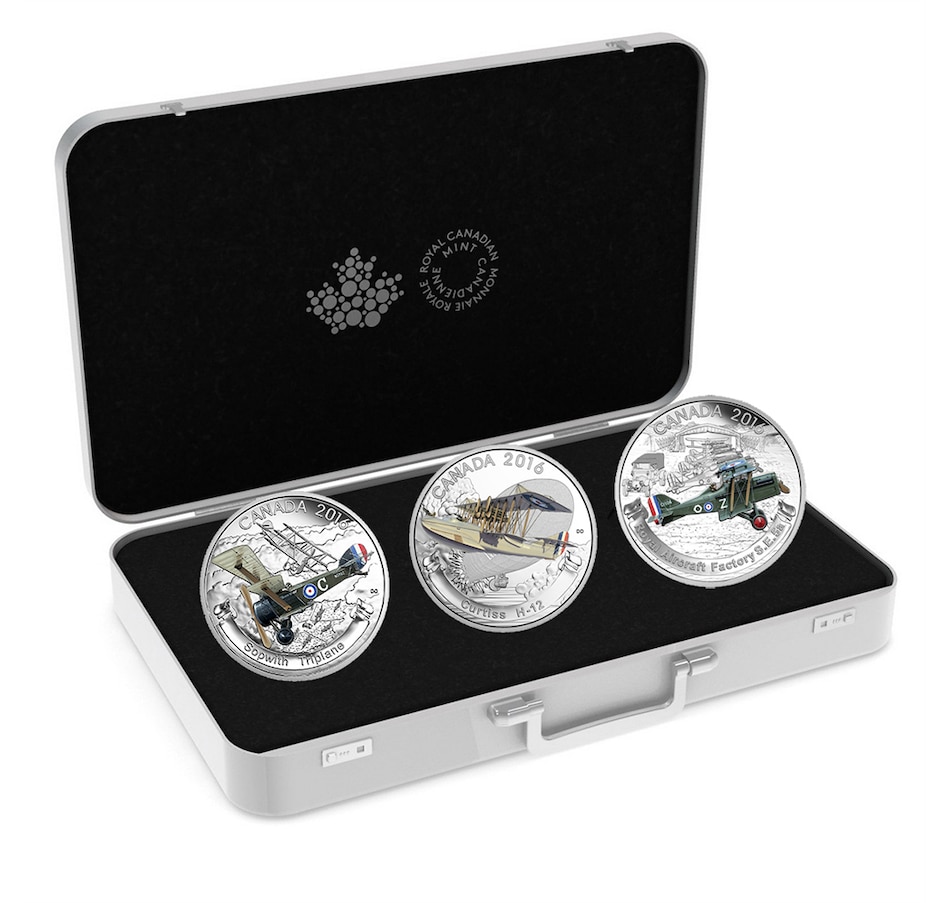

2016 $20 Fine Silver Proof Coin Set- Aircraft of the First World War
714-379
$299.95
Free Shipping
or
12 Payments of $24.99
with
Product Overview
This 2016 $20 fine silver three-coin set is designed to showcase the aircrafts of the First World War series. These coins artistically create a striking contrast, using a near-flawless proof finish and selective colour. The coins honour the aircrafts that played an important role in reshaping warfare and redefining industry and transportation. Each coin weighs just over one ounce of pure silver and has a limited mintage of 7,500 coins. As a pure silver coins struck by the Royal Canadian Mint, this item is HST/GST exempt.
The coins are engraved with the word "Canada", the date "1916" and the following details for each:
Coin #1- "Royal Aircraft Factory S.E.5a"
Coin #2- "The Sopwith Triplane"
Coin #3- "Curtiss H-12"
The back design features a effigy of King George V, by Sir Edward B. MacKennal, as used on Canadian coins during the First World War period.
Did You Know?
• The Royal Aircraft Factory S.E.5a ("S.E." for Scout Experiment, and "a" for improved) is a British single engine (a geared 200 hp Hispano-Suiza) fighter aircraft. It is a biplane that was used in World War I, by the Royal Flying Corps. As the required training time for new pilots was short, the Royal Aircraft Factory S.E.5a was specifically designed to be simple to fly. The aircraft was inherently stable, making it an excellent gunnery platform, but it was also quite maneuverable. It was one of the fastest aircraft of the war at 138 mph (222 km/h). It was comfortable, with a good all-round view, and retained its performance and maneuverability at high level. It was useful in both offence and defence, with a strong design, construction and a reliable engine.
•The Sopwith Triplane was famously flown by No. 10 Naval Squadron "B" flight, better known as "The Black Flight". This all-Canadian flight was commanded by the ace (a term given to pilots with 5 aerial victories) Raymond Collishaw. Their aircraft, named Black Maria, Black Prince, Black George, Black Death and Black Sheep, could be distinguished by their engine cowling, wheel disc covers, and metal forward fuselage decking that was painted black with the names on the sides in white lettering. The triplane's combat debut was highly successful. The new fighter's exceptional rate of climb, faster roll rate, maximum view, excellent maneuverability, and high service ceiling gave it a marked advantage over the biplane. The Black Flight claimed 87 German aircraft in three months while equipped with the triplane.
•The Curtiss H-12 was a patrol-bomber flying-boat, and had a four man crew. Its maximum speed was 136.79 km/h at 610 m, with an endurance of 6 hours at cruising speed. It had an armament of four flexible Lewis machine-guns, and either four 45 kg or two 104 kg bombs.
Includes:
• "Royal Aircraft Factory S.E.5a" silver coin
• "The Sopwith Triplane" silver coin
• "Curtiss H-12" silver coin
Warranty Information:
This product comes with a 30-day warranty through TSC.
The coins are engraved with the word "Canada", the date "1916" and the following details for each:
Coin #1- "Royal Aircraft Factory S.E.5a"
Coin #2- "The Sopwith Triplane"
Coin #3- "Curtiss H-12"
The back design features a effigy of King George V, by Sir Edward B. MacKennal, as used on Canadian coins during the First World War period.
Did You Know?
• The Royal Aircraft Factory S.E.5a ("S.E." for Scout Experiment, and "a" for improved) is a British single engine (a geared 200 hp Hispano-Suiza) fighter aircraft. It is a biplane that was used in World War I, by the Royal Flying Corps. As the required training time for new pilots was short, the Royal Aircraft Factory S.E.5a was specifically designed to be simple to fly. The aircraft was inherently stable, making it an excellent gunnery platform, but it was also quite maneuverable. It was one of the fastest aircraft of the war at 138 mph (222 km/h). It was comfortable, with a good all-round view, and retained its performance and maneuverability at high level. It was useful in both offence and defence, with a strong design, construction and a reliable engine.
•The Sopwith Triplane was famously flown by No. 10 Naval Squadron "B" flight, better known as "The Black Flight". This all-Canadian flight was commanded by the ace (a term given to pilots with 5 aerial victories) Raymond Collishaw. Their aircraft, named Black Maria, Black Prince, Black George, Black Death and Black Sheep, could be distinguished by their engine cowling, wheel disc covers, and metal forward fuselage decking that was painted black with the names on the sides in white lettering. The triplane's combat debut was highly successful. The new fighter's exceptional rate of climb, faster roll rate, maximum view, excellent maneuverability, and high service ceiling gave it a marked advantage over the biplane. The Black Flight claimed 87 German aircraft in three months while equipped with the triplane.
•The Curtiss H-12 was a patrol-bomber flying-boat, and had a four man crew. Its maximum speed was 136.79 km/h at 610 m, with an endurance of 6 hours at cruising speed. It had an armament of four flexible Lewis machine-guns, and either four 45 kg or two 104 kg bombs.
Includes:
• "Royal Aircraft Factory S.E.5a" silver coin
• "The Sopwith Triplane" silver coin
• "Curtiss H-12" silver coin
This product comes with a 30-day warranty through TSC.