2020 Complete 13 Silver Coin Set- Floral Emblems Of Canada
714-378
$649.95
Free Shipping
or
12 Payments of $54.16
with
Product Overview
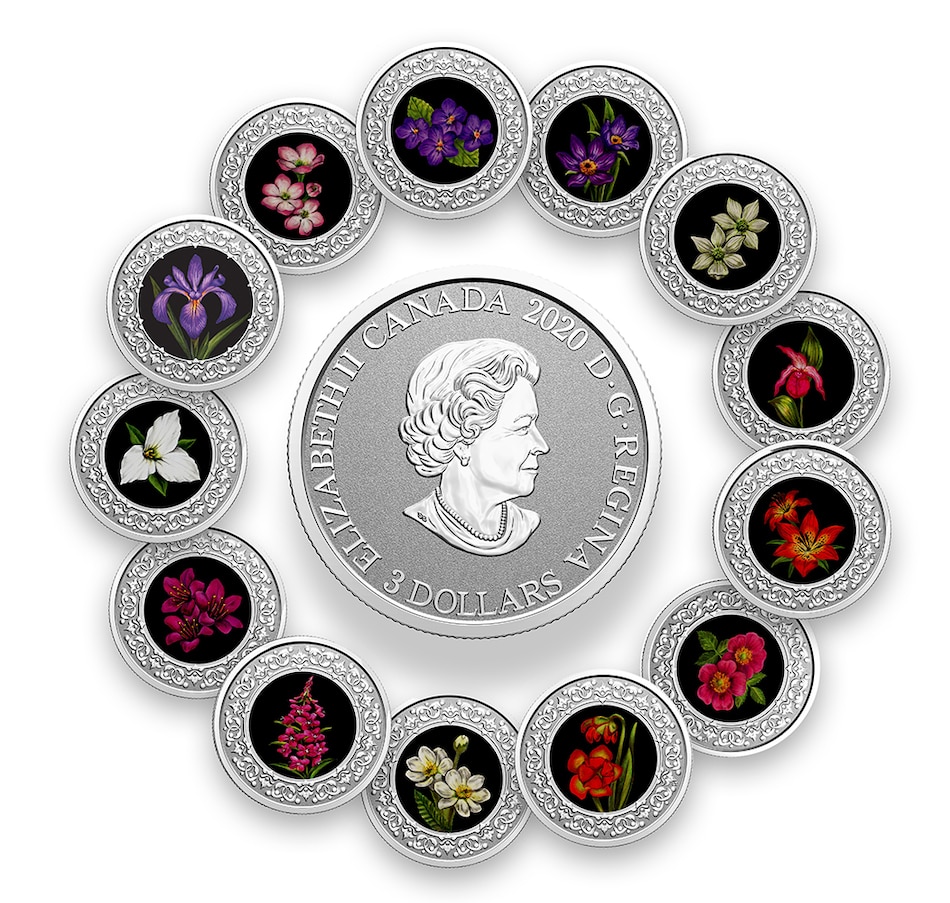
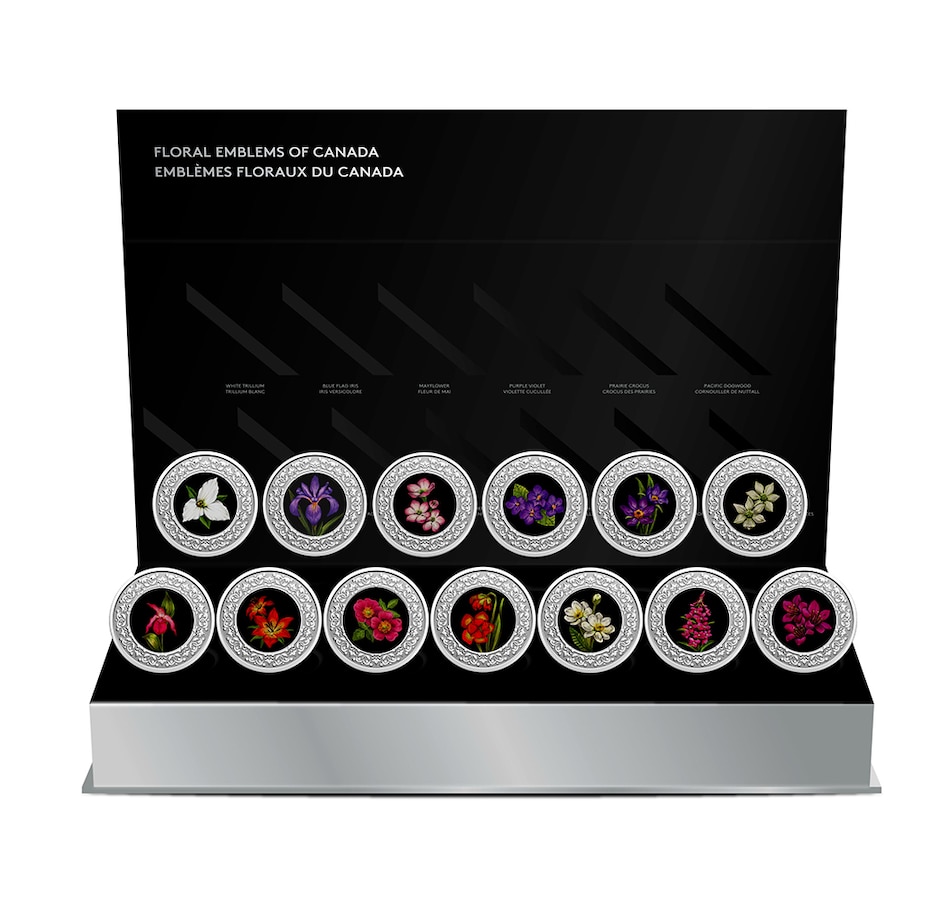
The maple leaf is Canada's most famous botanical icon on a nation level, but every province and territory also has its own official floral emblem, too. These 13 flowering symbols are the featured stars of the new Floral Emblems of Canada series. Styled like vintage silver jewellery, each coin highlights the diverse beauty of the floral emblems that grow in Canada, and outlined individually below:
• White Trillium (Ontario)- $3, 2020: Ontario chose the trillium as its provincial flower in 1937. This white flower grows in the forest in the springtime. It is called the trillium because it has three petals and three leaves.
• Blue Flag Iris (Quebec)- $3, 2020: The Madonna lily which looks like the heraldic fleur-de-lis on the provincial flag was Quebec’s flower for 36 years. It. This lily lily is the symbol of French culture in France and Québec, but it does not grow naturally in the province. Therefore, in 1999 Quebec chose a new flower that grows throughout the province, the blue flag iris.
• Mayflower (Nova Scotia)- $3, 2020: Nova Scotia selected the mayflower as its floral emblem in 1901. The mayflower grows along the East coast of North America. Early American settlers called it mayflower because they saw it as the first flower of spring. They named it after their ship, which carried them to North America in 1620.
• Purple Violet (New Brunswick)- $3, 2020: This small purple or dark blue flower grows in wet meadows and forests. It grows very well all over New Brunswick, and the purple violet was chosen as the provincial flower in 1936.
• Prairie Crocus (Manitoba)- $3, 2020: The lavender coloured prairie crocus has been Manitoba’s flower for almost a hundred years. Children in Manitoba chose it in a vote in 1906. It blooms very early in the spring, sometimes even before all the snow has melted.
• Pacific Dogwood (British Columbia)- $3, 2020: The Pacific dogwood has been British Columbia’s floral emblem since 1956. These big, white flowers bloom on tall trees in April and May.
• Lady’s Slipper (Prince Edward Island)- $3, 2020: Prince Edward Island adopted the lady’s slipper as its floral emblem in 1947. The flower gets its name from its petals, which are shaped like a woman’s shoe. It grows in the cool shade of the forest and it blooms in the springtime.
• Western Red Lily (Saskatchewan)- $3, 2020: Saskatchewan selected the Western red lily as its floral emblem in 1941. This tall, bright red flower grows in meadows and light forests.
• Wild Rose (Alberta)- $3, 2020: Alberta school children chose the pink, prickly wild rose as Alberta’s flower in 1930. It grows across Canada from Quebec to British Columbia.
• Pitcher Plant (Newfoundland and Labrador)- $3, 2020: The pitcher plant is Newfoundland and Labrador’s provincial flower. Newfoundland selected this plant as its floral emblem in 1954. It is called the pitcher plant because part of it can fill with water like a pitcher. Insects get trapped in the water and the plant eats them.
• Mountain Avens (Northwest Territories)- $ 3, 2021: The Northwest Territories selected the mountain avens as its territorial flower in 1957. This short, white flower with small leaves can grow in high, rocky ground.
• Fireweed (Yukon)- $3, 2021: The Yukon chose the fireweed as its floral emblem in 1957. The fireweed is a tall plant with many small, dark pink flowers. It grows in places like clearings or next to roads and rivers. It is called "fireweed" because it is one of the first plants to grow after a fire.
• Purple Saxifrage (Nunavut)- $3, 2021: Nunavut’s purple saxifrage grows well in cool weather. It is a small, bright-purple flower that grows like a mat over rocks and gravel. It can be found growing all over Nunavut, which is why the territory chose it as its floral emblem in 2000.
• HST/GST exempt
Includes:
• 2020 Complete 13 Silver Coin Set- Floral Emblems Of Canada
Warranty Information:
This product comes with a 30-day warranty through TSC.
• White Trillium (Ontario)- $3, 2020: Ontario chose the trillium as its provincial flower in 1937. This white flower grows in the forest in the springtime. It is called the trillium because it has three petals and three leaves.
• Blue Flag Iris (Quebec)- $3, 2020: The Madonna lily which looks like the heraldic fleur-de-lis on the provincial flag was Quebec’s flower for 36 years. It. This lily lily is the symbol of French culture in France and Québec, but it does not grow naturally in the province. Therefore, in 1999 Quebec chose a new flower that grows throughout the province, the blue flag iris.
• Mayflower (Nova Scotia)- $3, 2020: Nova Scotia selected the mayflower as its floral emblem in 1901. The mayflower grows along the East coast of North America. Early American settlers called it mayflower because they saw it as the first flower of spring. They named it after their ship, which carried them to North America in 1620.
• Purple Violet (New Brunswick)- $3, 2020: This small purple or dark blue flower grows in wet meadows and forests. It grows very well all over New Brunswick, and the purple violet was chosen as the provincial flower in 1936.
• Prairie Crocus (Manitoba)- $3, 2020: The lavender coloured prairie crocus has been Manitoba’s flower for almost a hundred years. Children in Manitoba chose it in a vote in 1906. It blooms very early in the spring, sometimes even before all the snow has melted.
• Pacific Dogwood (British Columbia)- $3, 2020: The Pacific dogwood has been British Columbia’s floral emblem since 1956. These big, white flowers bloom on tall trees in April and May.
• Lady’s Slipper (Prince Edward Island)- $3, 2020: Prince Edward Island adopted the lady’s slipper as its floral emblem in 1947. The flower gets its name from its petals, which are shaped like a woman’s shoe. It grows in the cool shade of the forest and it blooms in the springtime.
• Western Red Lily (Saskatchewan)- $3, 2020: Saskatchewan selected the Western red lily as its floral emblem in 1941. This tall, bright red flower grows in meadows and light forests.
• Wild Rose (Alberta)- $3, 2020: Alberta school children chose the pink, prickly wild rose as Alberta’s flower in 1930. It grows across Canada from Quebec to British Columbia.
• Pitcher Plant (Newfoundland and Labrador)- $3, 2020: The pitcher plant is Newfoundland and Labrador’s provincial flower. Newfoundland selected this plant as its floral emblem in 1954. It is called the pitcher plant because part of it can fill with water like a pitcher. Insects get trapped in the water and the plant eats them.
• Mountain Avens (Northwest Territories)- $ 3, 2021: The Northwest Territories selected the mountain avens as its territorial flower in 1957. This short, white flower with small leaves can grow in high, rocky ground.
• Fireweed (Yukon)- $3, 2021: The Yukon chose the fireweed as its floral emblem in 1957. The fireweed is a tall plant with many small, dark pink flowers. It grows in places like clearings or next to roads and rivers. It is called "fireweed" because it is one of the first plants to grow after a fire.
• Purple Saxifrage (Nunavut)- $3, 2021: Nunavut’s purple saxifrage grows well in cool weather. It is a small, bright-purple flower that grows like a mat over rocks and gravel. It can be found growing all over Nunavut, which is why the territory chose it as its floral emblem in 2000.
• HST/GST exempt
Includes:
• 2020 Complete 13 Silver Coin Set- Floral Emblems Of Canada
Warranty Information:
This product comes with a 30-day warranty through TSC.