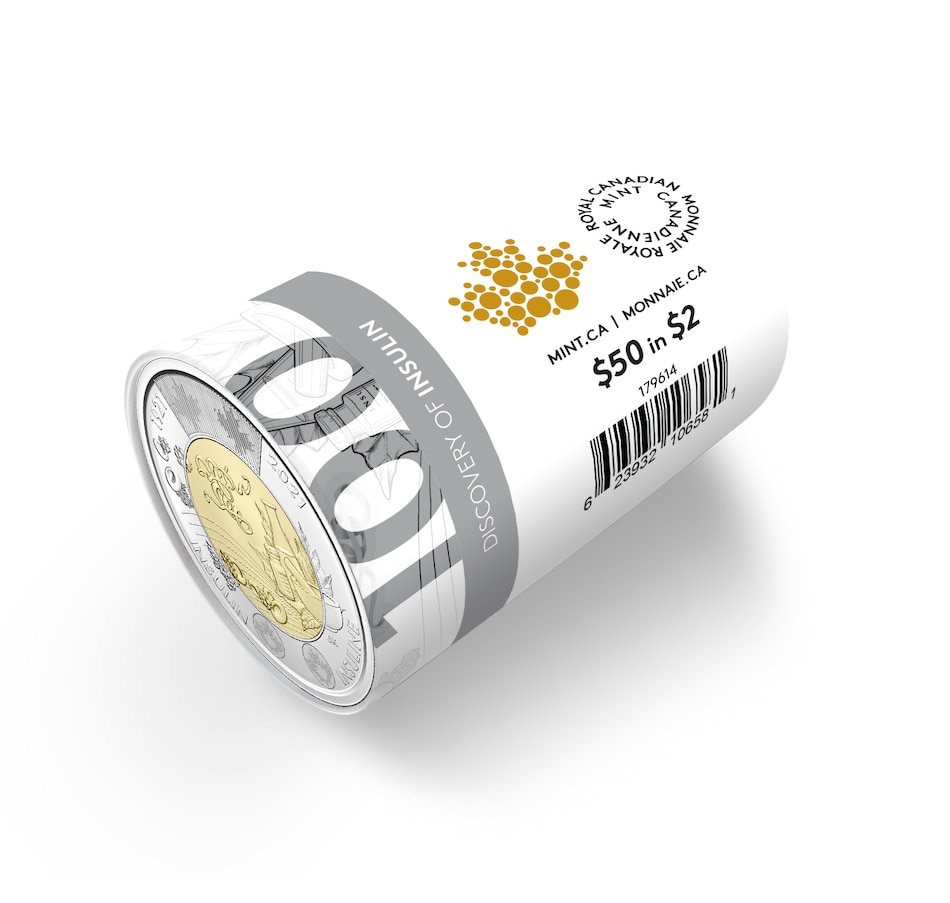
2021 $2 Special Wrap Roll 100th Anniversary of the Discovery of Insulin (classic engraved, 25 coins per roll)
703-708
$99.95
Free Shipping
or
12 Payments of $8.32
with
Product Overview
Canada's newest $2 commemorative coin marks the 100th anniversary of one of Canada's greatest contributions to medical research: the discovery of insulin in 1921 by Frederick Banting and his assistant Charles Best. This special wrap roll includes 25 brilliant uncirculated classic engraved versions of the $2 commemorative coin. Mintage is limited to just 10,000 rolls.
Each roll instantly adds 25 coloured versions of the 2021 $2 commemorative coin to your collection, and each classic engraved coin will serve as a lasting reminder of how a Canadian medical breakthrough has had an immeasurable global impact over the last century.
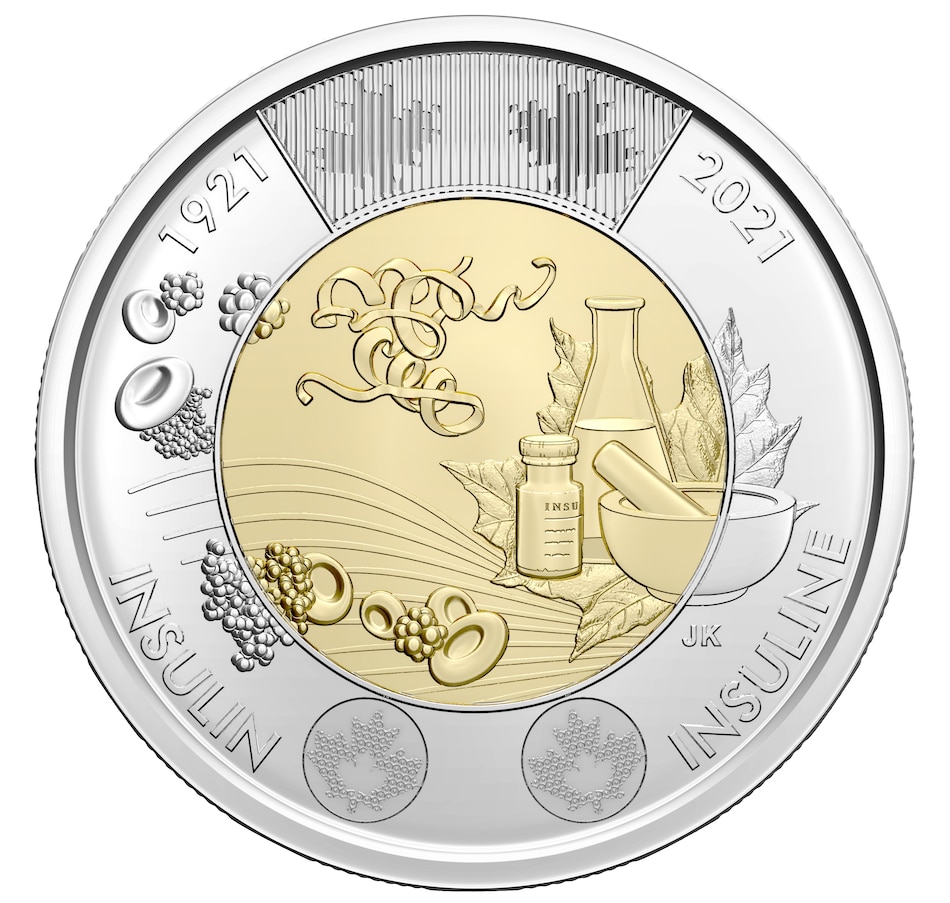
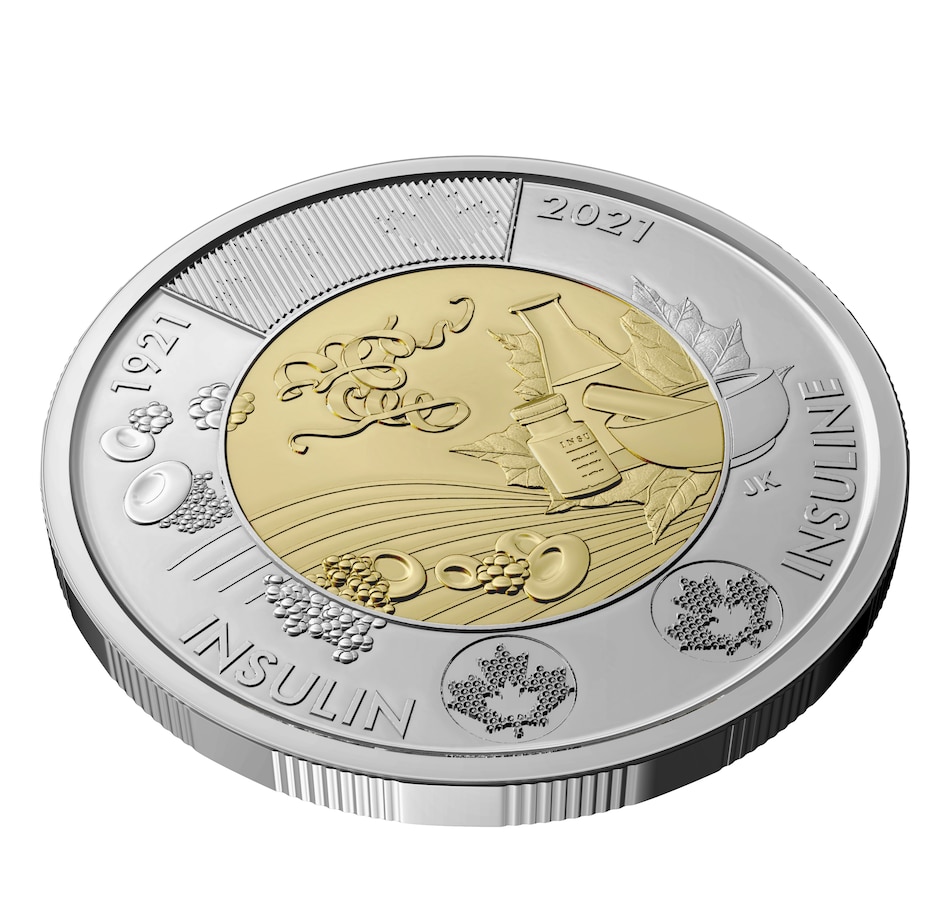
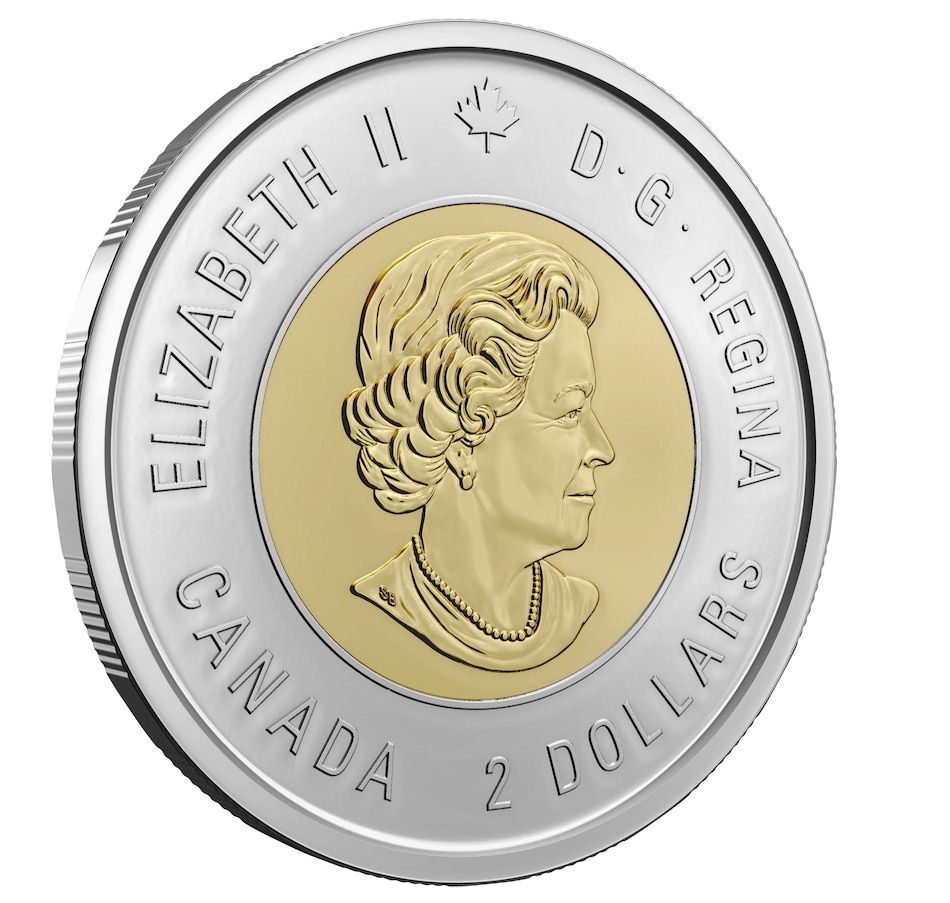
Designed by Canadian artist Jesse Koreck, the reverse is double dated ("1921 2021") to commemorate the 100th anniversary of a Canadian medical innovation. The discovery of insulin at the University of Toronto is represented by a maple leaf and traditional symbols: an early insulin vial, an Erlenmeyer flask, and a mortar and pestle. The inner core shows insulin in monomeric form, while the depiction of the hormone at work in the bloodstream extends onto the outer ring. The obverse features the effigy of Her Majesty Queen Elizabeth II by Susanna Blunt.
About Insulin
In 1921, a young surgeon named Frederick Banting and his assistant Charles Best figured out how to remove insulin from a dog's pancreas. Skeptical colleagues said the stuff looked like "thick brown muck," but little did they know this would lead to life and hope for millions of people with diabetes.
With this murky concoction, Banting and Best kept another dog with severe diabetes alive for 70 days—the dog died only when there was no more extract. With this success, the researchers, along with the help of colleagues J. B. Collip and John Macleod, went a step further. A more refined and pure form of insulin was developed, this time from the pancreases of cattle.
In January 1922, Leonard Thompson, a 14-year-old boy dying from diabetes in a Toronto hospital, became the first person to receive an injection of insulin. Within 24 hours, Leonard's dangerously high blood glucose levels dropped to near-normal levels. The news about insulin spread around the world like wildfire. In 1923, Banting and Macleod received the Nobel Prize in Medicine, which they shared with Best and Collip. Thank you, diabetes researchers!
Soon after, the medical firm Eli Lilly started large-scale production of insulin, and it wasn't long before there was enough insulin to supply the entire North American continent. In the decades to follow, manufacturers developed a variety of slower-acting insulins, the first introduced by Novo Nordisk Pharmaceuticals, Inc., in 1936.
Insulin from cattle and pigs was used for many years to treat diabetes and saved millions of lives, but it wasn't perfect, as it caused allergic reactions in many patients. The first genetically engineered, synthetic "human" insulin was produced in 1978 using E. coli bacteria to produce the insulin. Eli Lilly went on in 1982 to sell the first commercially available biosynthetic human insulin under the brand name Humulin.
Insulin now comes in many forms, from regular human insulin identical to what the body produces on its own, to ultra-rapid and ultra-long acting insulins. Thanks to decades of research, people with diabetes can choose from a variety of formulas and ways to take their insulin based on their personal needs and lifestyles. From Humalog to Novolog and insulin pens to pumps, insulin has come a long way. It may not be a cure for diabetes, but it's literally a life saver.
• Mintage: 10,000 rolls
Includes:
• 2021 $2 Discovery of Insulin SWR Classic Engraved
Each roll instantly adds 25 coloured versions of the 2021 $2 commemorative coin to your collection, and each classic engraved coin will serve as a lasting reminder of how a Canadian medical breakthrough has had an immeasurable global impact over the last century.
Designed by Canadian artist Jesse Koreck, the reverse is double dated ("1921 2021") to commemorate the 100th anniversary of a Canadian medical innovation. The discovery of insulin at the University of Toronto is represented by a maple leaf and traditional symbols: an early insulin vial, an Erlenmeyer flask, and a mortar and pestle. The inner core shows insulin in monomeric form, while the depiction of the hormone at work in the bloodstream extends onto the outer ring. The obverse features the effigy of Her Majesty Queen Elizabeth II by Susanna Blunt.
About Insulin
In 1921, a young surgeon named Frederick Banting and his assistant Charles Best figured out how to remove insulin from a dog's pancreas. Skeptical colleagues said the stuff looked like "thick brown muck," but little did they know this would lead to life and hope for millions of people with diabetes.
With this murky concoction, Banting and Best kept another dog with severe diabetes alive for 70 days—the dog died only when there was no more extract. With this success, the researchers, along with the help of colleagues J. B. Collip and John Macleod, went a step further. A more refined and pure form of insulin was developed, this time from the pancreases of cattle.
In January 1922, Leonard Thompson, a 14-year-old boy dying from diabetes in a Toronto hospital, became the first person to receive an injection of insulin. Within 24 hours, Leonard's dangerously high blood glucose levels dropped to near-normal levels. The news about insulin spread around the world like wildfire. In 1923, Banting and Macleod received the Nobel Prize in Medicine, which they shared with Best and Collip. Thank you, diabetes researchers!
Soon after, the medical firm Eli Lilly started large-scale production of insulin, and it wasn't long before there was enough insulin to supply the entire North American continent. In the decades to follow, manufacturers developed a variety of slower-acting insulins, the first introduced by Novo Nordisk Pharmaceuticals, Inc., in 1936.
Insulin from cattle and pigs was used for many years to treat diabetes and saved millions of lives, but it wasn't perfect, as it caused allergic reactions in many patients. The first genetically engineered, synthetic "human" insulin was produced in 1978 using E. coli bacteria to produce the insulin. Eli Lilly went on in 1982 to sell the first commercially available biosynthetic human insulin under the brand name Humulin.
Insulin now comes in many forms, from regular human insulin identical to what the body produces on its own, to ultra-rapid and ultra-long acting insulins. Thanks to decades of research, people with diabetes can choose from a variety of formulas and ways to take their insulin based on their personal needs and lifestyles. From Humalog to Novolog and insulin pens to pumps, insulin has come a long way. It may not be a cure for diabetes, but it's literally a life saver.
• Mintage: 10,000 rolls
Includes:
• 2021 $2 Discovery of Insulin SWR Classic Engraved