Set of Four Fishing Fly Prints, Matted with First Day Certificate
706-966
$59.96
Shipping: $9.99
or
12 Payments of $4.99
with
Product Overview
Fishing for many allows for quiet times away from the hustle and bustle of their everyday lives, the tranquility of nature and the prospect of luring a trophy fish to the line. These four official Canada Post stamp art prints convey why many are lured to the sport of fly-fishing, and provides the opportunity to capture this feeling all year round. This offering has been designed to introduce collectors to the wide variety of collector products offered by Canada Post.
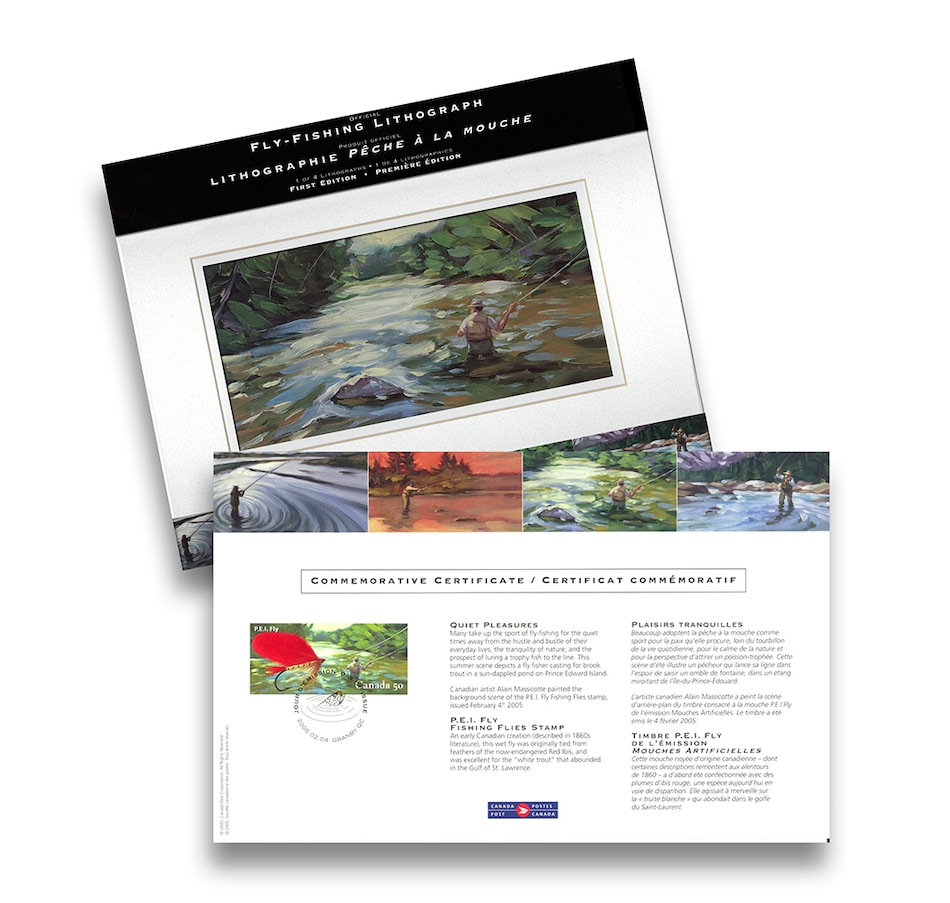
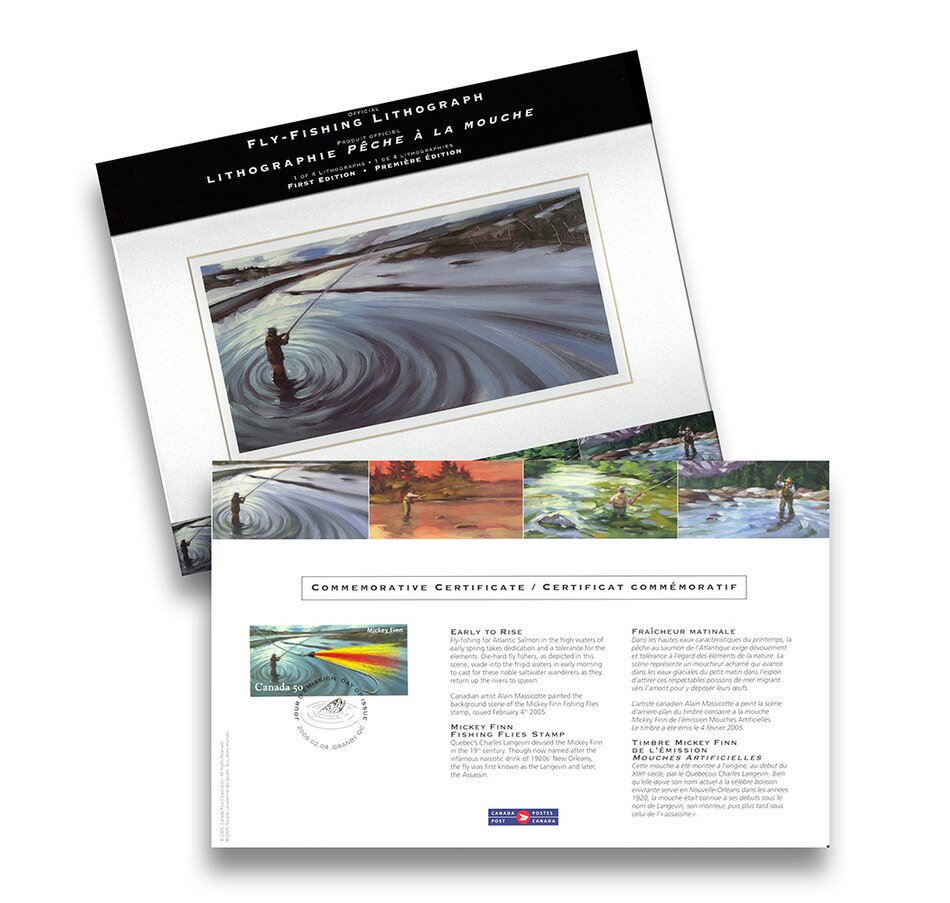
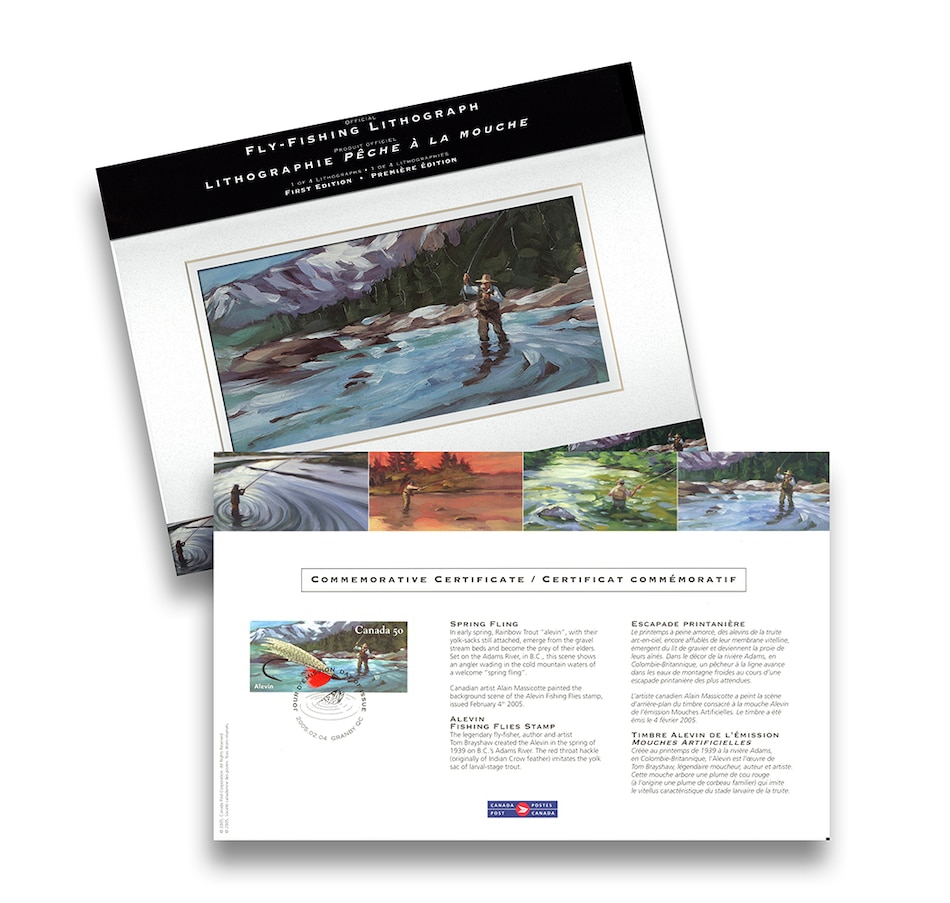
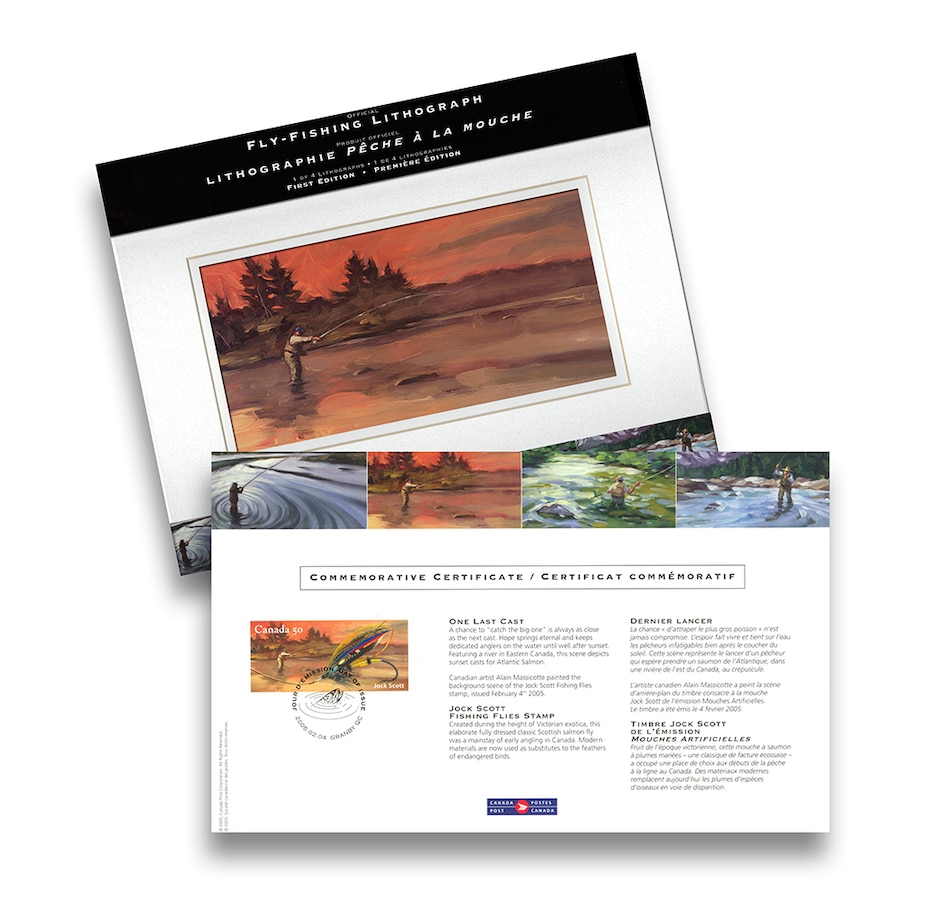
Every year Canada Post selects some of the most popular themes and best Canadian art to appear on its postage stamps. While this small "canvas" provides a thumbnail-size image of the designs, Canada Post sometimes seeks to showcase this art in a larger size worthy of framing. The collection includes four different 14" x 11" matted full-colour prints featuring the same art as used on the Canada Post Fishing Fly stamp series. The titles of the art are "Spring Fling," "One Last Cast," "Quiet Pleasures," and "Early to Rise." A certificate comes with each print which doubles as a first day of issue stamp cover, with a first-day cancellation stamp as part of the certificate.
Prints
• "Spring Fling" (Alevin fly): a fly fisher fishing rainbow trout in spring
• "One Last Cast" (Jock Scott fly): this scene depicts a fly fisher trying to get one last cast in before the sun goes down
• "Quiet Pleasures": (PEI fly): this summer scene depicts a fly fisher casting for brook trout in a sun-dappled pond on Prince Edward Island
• "Early to Rise" (Mickey Finn fly): as the sun comes up, a lone fisherman stands in shallow water for an early-morning cast
Flys
• Alevin fly: this fly is used with great success on the Adams River of BC, where large rainbow trout find it irresistible
• Jock Scott fly: the Jock Scott, used for salmon, is the most famous Scottish fly and has been a mainstay on Canadian rivers since colonial times; it remains one of the four most popular classic patterns in use today
• PEI fly: this fly, one of the earliest Canadian creations, was described in detail in the 1860s book, Salmon Fishing in Canada, and was originally tied from feathers of the now-endangered red ibis; it can be tied for either salmon or trout and in this stamp, it's tied for trout
• Mickey Finn Fly: the Mickey Finn, as it's now called, was created in the 19th century by Charles Langevin and was known at that time as the "Langevin." It was used on the Jacques-Cartier River in the Quebec City area and appears not to have been used or known outside of that region. In the 1930s, John Alden Knight learned of the fly at a private fishing club in New York and immediately recognized the value of this "Red and Yellow Bucktail." He used it with great success in 1936 and decided to rename the fly "The Assassin." Very shortly after, Knight's fishing partner, Gregory Clark (of the Toronto Star) changed the name once more, this time to "Mickey Finn." The fly is used for bass, pike, salmon and trout.
Includes:
• Set of Four Canada Post Fishing Fly Prints
Every year Canada Post selects some of the most popular themes and best Canadian art to appear on its postage stamps. While this small "canvas" provides a thumbnail-size image of the designs, Canada Post sometimes seeks to showcase this art in a larger size worthy of framing. The collection includes four different 14" x 11" matted full-colour prints featuring the same art as used on the Canada Post Fishing Fly stamp series. The titles of the art are "Spring Fling," "One Last Cast," "Quiet Pleasures," and "Early to Rise." A certificate comes with each print which doubles as a first day of issue stamp cover, with a first-day cancellation stamp as part of the certificate.
Prints
• "Spring Fling" (Alevin fly): a fly fisher fishing rainbow trout in spring
• "One Last Cast" (Jock Scott fly): this scene depicts a fly fisher trying to get one last cast in before the sun goes down
• "Quiet Pleasures": (PEI fly): this summer scene depicts a fly fisher casting for brook trout in a sun-dappled pond on Prince Edward Island
• "Early to Rise" (Mickey Finn fly): as the sun comes up, a lone fisherman stands in shallow water for an early-morning cast
Flys
• Alevin fly: this fly is used with great success on the Adams River of BC, where large rainbow trout find it irresistible
• Jock Scott fly: the Jock Scott, used for salmon, is the most famous Scottish fly and has been a mainstay on Canadian rivers since colonial times; it remains one of the four most popular classic patterns in use today
• PEI fly: this fly, one of the earliest Canadian creations, was described in detail in the 1860s book, Salmon Fishing in Canada, and was originally tied from feathers of the now-endangered red ibis; it can be tied for either salmon or trout and in this stamp, it's tied for trout
• Mickey Finn Fly: the Mickey Finn, as it's now called, was created in the 19th century by Charles Langevin and was known at that time as the "Langevin." It was used on the Jacques-Cartier River in the Quebec City area and appears not to have been used or known outside of that region. In the 1930s, John Alden Knight learned of the fly at a private fishing club in New York and immediately recognized the value of this "Red and Yellow Bucktail." He used it with great success in 1936 and decided to rename the fly "The Assassin." Very shortly after, Knight's fishing partner, Gregory Clark (of the Toronto Star) changed the name once more, this time to "Mickey Finn." The fly is used for bass, pike, salmon and trout.
Includes:
• Set of Four Canada Post Fishing Fly Prints